
-
Dee Agarwal explains why long-horizon thinking beats quarterly urgency, reshaping ROI, metrics, and sustainable business strategy.
Atlanta, GA, 14th April 2026, ZEXPRWIRE — There is a particular kind of organizational anxiety that sets in around the end of every quarter. Dashboards get refreshed compulsively. Leadership teams scramble to close gaps. Priorities that were carefully set in January quietly get replaced by whatever is loudest in March. It is a cycle most executives recognize, and one that business strategist and entrepreneur Deepak “Dee” Agarwal believes is quietly undermining the companies that fall into it.
.png)
Dee Agarwal has built a reputation for thinking about business strategy on a different timescale than most. Where many leaders optimize for the next ninety days, He tends to ask what a decision looks like across three years, five years, or the life of a customer relationship. It is a disposition that shapes not just how he plans, but how he structures teams, measures performance, and defines success.
“ROI is the lifeblood of any business strategy,” Dee Agarwal emphasizes. “It’s the compass that guides our decisions and ensures we’re putting our resources to work effectively. But a singular focus on ROI, without considering the underlying factors that influence it, can lead us astray.”
The instinct to zoom out and interrogate what is actually driving results sits at the center of his approach to long-horizon strategy. In his view, most organizations are not failing because they lack ambition. They are failing because they have designed their operating rhythms around urgency rather than direction.
The Problem with Urgency as a Default
Dee Agarwal is direct about the costs of always-on, reactive cultures. In his work advising leaders on organizational design, he argues that treating every problem as a fire drill trains teams to sprint when they should be building. “Urgency is sometimes necessary,” he caveats, “but it can’t be the operating system. Leaders need to create rhythms that allow teams to anticipate, plan, and process. Stability reduces fatigue.”
The long-horizon thinker, by contrast, distinguishes clearly between the decisions that need an answer today and the ones that deserve sustained attention. The former gets a process; the latter gets protected time and deliberate frameworks.
This is more than a philosophical preference. Dee Agarwal points to the compounding nature of strategic decisions; the way that a poorly considered platform choice or a misaligned hiring philosophy does not announce itself immediately, but shows up eighteen months later as a structural problem that is expensive to unwind. Planning well in advance, in his view, is not about predicting the future. It is about reducing the number of decisions you have to make under pressure.
Measuring What Actually Matters Over Time
One of the tensions in long-horizon strategy is the pressure to justify it with near-term metrics. Dee Agarwal pushes back on the instinct to reduce every initiative to a single number. “Don’t get bogged down in vanity metrics or industry benchmarks that don’t reflect your unique business strategy,” he advises. “The key is to identify metrics that directly tie back to your ROI objectives.”
In practice, this means building a portfolio of indicators that tell different stories over different time periods. He resists the temptation to flatten all of this into a single quarterly score. The metrics that matter most over a multi-year horizon often look unremarkable in the short term. Protecting them requires a leader who is willing to explain why.
Sustainability as a Strategic Frame
Perhaps the clearest expression of Dee Agarwal’s long-horizon thinking is in how he talks about sustainability; not in the narrow environmental sense, but as a lens for evaluating every significant business decision. He argues that the most successful organizations treat sustainability as a value multiplier rather than a cost center. “When businesses rethink what ‘value’ really means, they often discover that sustainable decisions are smart business decisions.”
That framing extends to talent, culture, and operations. A team that is chronically overloaded may deliver strong results in Q2, but it is quietly accumulating organizational debt that will surface later in turnover, disengagement, and missed opportunities. Dee Agarwal’s version of strategic planning accounts for this: building in recovery, capacity, and room for the kind of thinking that doesn’t appear on a Gantt chart.
The Long Game in Practice
None of this means Dee Agarwal dismisses execution or short-term results. The quarterly plan still exists. Targets still matter. But in his framework, they are expressions of a longer arc rather than ends in themselves.
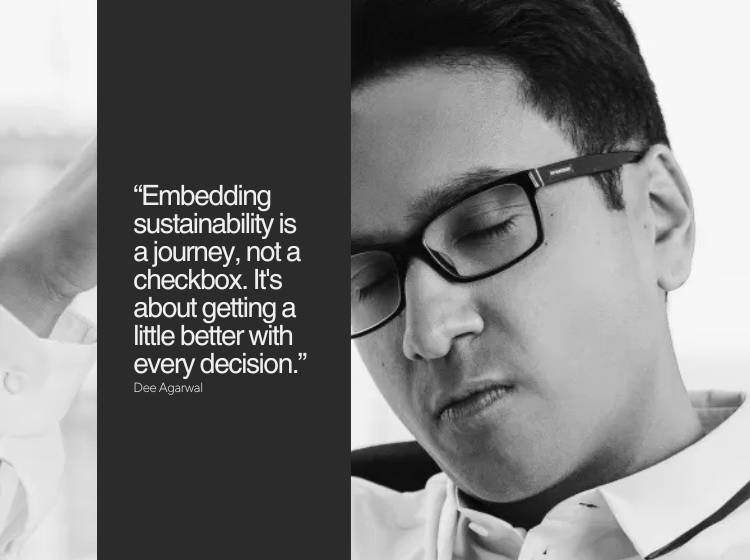
“Embedding sustainability is a journey, not a checkbox,” he notes, though the principle applies broadly. “It’s about getting a little better with every decision.”
The Post Beyond the Quarterly Plan: How Dee Agarwal Approaches Long-Horizon Strategy first appeared on ZEX PR Wire
